Building long-term wealth through saving and investing relies entirely on one powerful financial principle: compound interest. While most people understand the basic concept of compound growth, nearly everyone struggles to calculate accurate future returns with consistent recurring deposits. The average saver does not invest a single lump sum and walk away; they deposit small, fixed amounts every month into savings accounts, investment portfolios, retirement funds, and wealth-building accounts. Unfortunately, most generic financial calculators only support one-time principal calculations, completely ignoring the monthly deposits that define real-world personal finance.
This critical limitation leads to massively understated growth projections, broken financial goals, and poor savings decisions. If you want accurate, realistic insights into how your regular deposits grow over months and years, a standard calculator simply cannot deliver reliable results. This is why a compound interest calculator with monthly contributions is an essential tool for every everyday saver, new investor, and long-term financial planner.
Unlike basic tools, a dedicated compound interest calculator with monthly contributions is built specifically to factor in recurring monthly deposits, adjustable compounding frequencies, and variable interest rates to generate hyper-realistic wealth growth forecasts. In this in-depth, beginner-friendly guide, we will cover why monthly contribution calculations matter, flaws of generic calculators, key tool features, a complete step-by-step usage tutorial, common calculation errors, and actionable tips to maximize your savings growth.
Why Monthly Contributions Are Critical to Compound Growth Calculations
To understand why a specialized compound interest calculator with monthly contributions outperforms standard tools, you first need to recognize how recurring deposits transform compound growth dynamics. Traditional compound interest math only calculates earnings on a fixed initial principal sum. It assumes no additional money is added over time, which almost never matches real consumer saving behavior.
Nearly all personal wealth building happens through micro-investing and monthly saving habits. Whether you are putting money aside for an emergency fund, a home down payment, college tuition, or long-term retirement, consistent monthly deposits are the driving force behind portfolio growth. Over five, ten, or twenty years, these recurring contributions add up to far more wealth than the initial principal alone. More importantly, every new monthly deposit immediately begins earning compound interest, creating a layered snowball effect that accelerates growth exponentially over time.
Generic calculators fail to account for this layered growth. They only show growth from your starting balance, leaving out thousands of dollars in additional contributions and their accumulated interest. This creates a massive gap between projected results and actual future savings value. A purpose-built compound interest calculator with monthly contributions eliminates this gap entirely. It tracks every monthly deposit individually, calculates compound earnings for each incremental sum, and compiles a full, accurate overview of your total future wealth. This level of precision is mandatory for setting realistic budgets, savings targets, and long-term financial goals.
Major Flaws of Standard Compound Interest Calculators
Most free online compound interest tools look helpful on the surface, but they contain critical design flaws that make them useless for anyone saving with monthly recurring deposits. Understanding these weaknesses will help you see why upgrading to a compound interest calculator with monthly contributions is essential for reliable financial planning.
First and most importantly, standard calculators treat savings as static. They operate under the false assumption that users only deposit money once and never add additional funds. This rigid framework completely invalidates results for anyone who practices regular monthly saving, which accounts for the vast majority of casual savers and retail investors. The final numbers these tools generate are often drastically lower than real-world outcomes, leaving users discouraged or misinformed about their financial potential.
Second, basic tools lack granular frequency customization. Many simple calculators only offer annual compounding and annual contribution settings, which do not align with modern banking and investment structures. Most high-yield savings accounts, index funds, and retirement plans compound interest monthly and accept monthly deposits. Without matching this monthly cadence, calculations lose accuracy and fail to reflect how real financial accounts grow.
Third, generic calculators do not separate key financial metrics. They show one final lump sum number with no breakdown of total personal contributions versus earned compound interest. Users cannot tell how much they saved versus how much their money grew passively, making it impossible to evaluate the true power of compounding or adjust their saving strategy effectively.
Lastly, standard tools skip long-term trend visualization. They do not provide month-by-month or year-by-year growth breakdowns, so users cannot track incremental progress, identify growth acceleration points, or test small monthly contribution increases. A premium compound interest calculator with monthly contributions fixes every one of these issues with tailored features built for active, ongoing saving habits.
Key Features of a Quality Compound Interest Calculator With Monthly Contributions
A top-tier compound interest calculator with monthly contributions includes unique, user-focused features designed to model real-life saving and investing scenarios. These core functionalities separate professional-grade calculators from basic, inaccurate generic tools and deliver actionable financial data for all users.
Dedicated monthly contribution input field: The flagship feature that defines this tool. Users can input exact recurring monthly deposit amounts, whether they save $50, $200, or $1,000 every month. The calculator integrates these regular deposits directly into its compound formula for precise dynamic growth modeling.
Flexible compounding frequency options: It supports daily, monthly, quarterly, and annual compounding to match any savings account, CD, or investment portfolio structure. Since most consumer-focused financial products compound monthly, this setting ensures maximum calculation accuracy for everyday users.
Combined principal + recurring deposit calculations: The tool accounts for both your initial lump-sum principal and every ongoing monthly contribution, calculating compound interest on each individual deposit to mirror real bank and investment math perfectly.
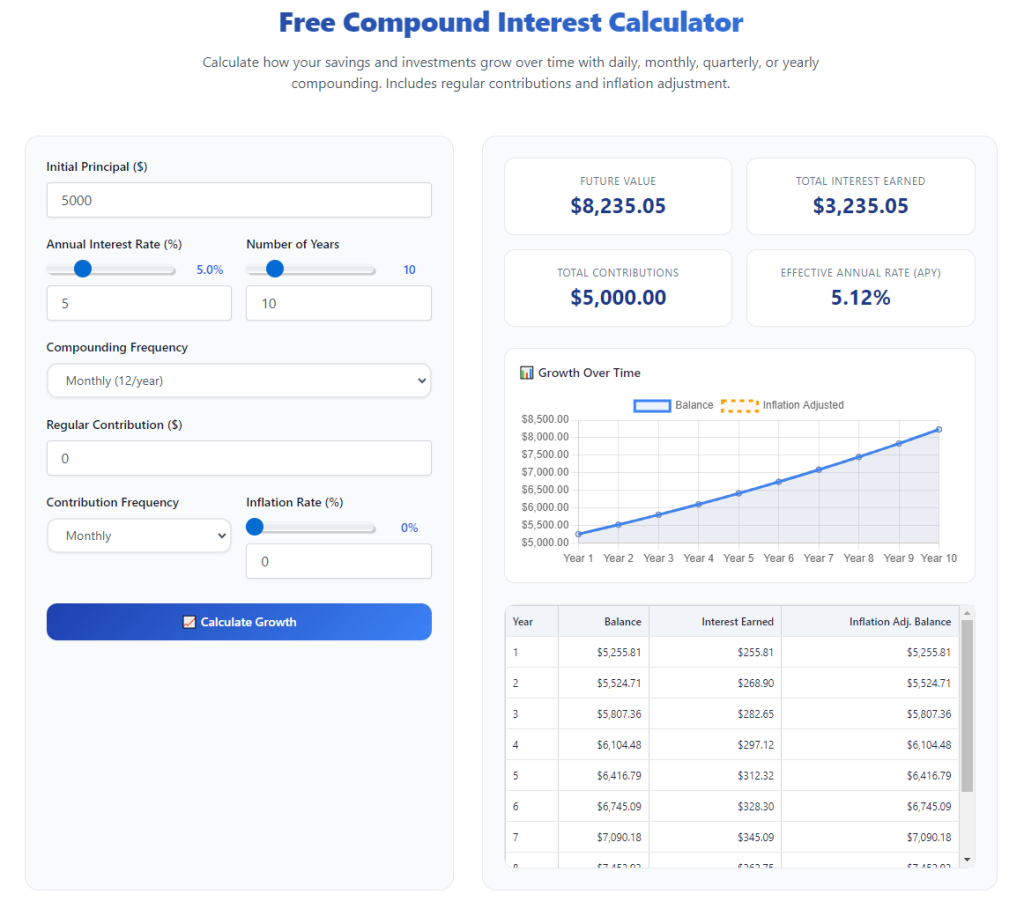
Detailed yearly growth breakdown reports: Instead of a single final figure, it generates annual summaries showing total money deposited, total compound interest earned, and ending yearly balances. This lets users watch their wealth snowball over time and identify when compounding begins to outpace personal contributions.
Adjustable timeline settings: Users can model short-term goals spanning a few years and long-term growth plans spanning multiple decades, making the calculator versatile for every type of savings objective.
Clear metric separation: It distinctly displays total out-of-pocket contributions versus passive interest earnings, helping users understand exactly how much work compound interest is doing for their financial growth.
Top Real-World Use Cases for This Calculator Tool
A reliable compound interest calculator with monthly contributions serves countless everyday financial planning needs, making it one of the most versatile tools for personal finance management. Below are the most common and valuable use cases for users of all financial experience levels.
Short-term goal savings planning: Whether you are saving for a vacation, down payment, new vehicle, or emergency fund, consistent monthly deposits are your primary growth strategy. This calculator accurately forecasts your future balance, helping you set realistic monthly savings targets and timeline expectations.
Long-term investment forecasting: Retail investors who make monthly micro-investments into index funds, ETFs, or brokerage accounts can model long-term portfolio growth with precise accuracy. The tool shows how small, regular investments compound into substantial wealth over decades.
Retirement savings estimation: Most retirement planning relies on monthly payroll contributions. Using a compound interest calculator with monthly contributions lets workers forecast 401(k) and IRA growth accurately, adjust monthly contribution rates, and ensure they stay on track for retirement targets.
Financial education and budgeting: New savers and students can learn firsthand how consistent small deposits beat sporadic large deposits thanks to compound timing. The visual breakdowns simplify complex finance concepts and build better long-term money habits.
Savings strategy comparison: Users can test multiple scenarios, such as raising monthly deposits by $100 or switching to a higher-interest account, to compare outcomes and optimize their personal savings strategy for maximum growth.
Step-by-Step Guide to Using a Compound Interest Calculator With Monthly Contributions
This simple, repeatable workflow works for all premium versions of acompound interest calculator with monthly contributions. Follow these steps to generate 100% accurate, personalized savings projections in under one minute.
Step 1: Enter Your Initial Principal Balance
Start by inputting your current existing savings or investment balance. This is the lump sum you already have saved before adding new monthly contributions. If you are starting fresh with no existing savings, enter zero to build a projection from the ground up. Double-check this number to avoid foundational calculation errors.
Step 2: Input Your Exact Monthly Contribution Amount
Locate the dedicated monthly contribution field and type in the fixed amount you plan to deposit consistently every month. For the most realistic results, use your average sustainable monthly savings amount. Avoid overestimating this number, as it will create unachievable financial projections.
Step 3: Enter the Annual Interest Rate
Input the annual percentage yield from your savings account, investment fund, or financial product. Use the current real rate offered by your provider rather than speculative or overly optimistic rates to ensure practical, trustworthy results.
Step 4: Select Matching Compounding Frequency
Choose the compounding frequency that matches your account terms. For most standard savings and investment accounts, monthly compounding is the default setting. Aligning this setting perfectly with your actual account rules eliminates major calculation discrepancies.
Step 5: Set Your Savings Timeline
Enter the total number of years you plan to maintain your monthly savings routine. This can range from 1–2 years for short-term goals to 20–30 years for long-term wealth and retirement planning.
Step 6: Generate and Review Full Projection Results
Run the calculation to view your final projected balance, total monthly contributions accumulated over time, total compound interest earned, and a full year-by-year growth breakdown. Take time to review how your balance grows slowly in early stages and accelerates significantly in later years due to compounding momentum.
Step 7: Test Optimized Savings Scenarios
Adjust your monthly contribution amount slightly to compare different outcomes. Even a small increase in monthly deposits will show a dramatic difference in long-term growth, helping you decide how much extra to save each month to reach your financial goals faster.
Common Calculation Mistakes to Avoid
Even with a precise compound interest calculator with monthly contributions, simple user errors can skew results and mislead your financial planning. Avoid these frequent mistakes to keep all projections accurate and reliable.
Mismatched compounding and contribution frequency: Using annual compounding for accounts that compound monthly will drastically understate your total interest earnings. Always match the tool’s settings to your real account structure.
Overestimating interest rates: Speculating on high future returns creates unrealistic expectations. Stick to proven, average long-term rates for conservative, dependable planning.
Forgetting ongoing monthly deposits: Accidentally leaving the contribution field blank will revert the tool to basic lump-sum calculations, defeating the core purpose of using a specialized monthly contribution calculator.
Ignoring incremental savings growth: Failing to test small monthly contribution increases means you miss opportunities to maximize long-term compound growth with minimal monthly budget changes.
Pro Tips to Maximize Your Calculator Results & Savings Growth
Use these expert tips to fully leverage a compound interest calculator with monthly contributions and build a more effective long-term savings strategy.
- Run quarterly projection updates: Whenever you adjust your monthly savings amount or switch financial accounts, refresh your calculations to keep your financial plan current and accurate.
- Compare incremental contribution changes: Test $50 or $100 monthly increases to visualize how tiny consistent adjustments create massive long-term wealth gains.
- Analyze interest versus principal growth: Use the metric breakdowns to see when passive compound interest begins outearning your personal monthly contributions, a key milestone in wealth building.
- Balance short-term and long-term goals: Use different timeline settings to plan both immediate savings targets and long-term financial security simultaneously.
Final Thoughts
Compound interest is the most powerful tool in personal finance, but it is useless without accurate modeling that matches real saving behavior. Generic compound interest calculators fail the average user because they ignore the monthly recurring deposits that fuel everyday wealth growth. They deliver incomplete, inaccurate data that can derail budgets, savings goals, and long-term financial plans.
A dedicated compound interest calculator with monthly contributions solves this problem entirely. It is engineered for real-world saving habits, integrating initial principal, consistent monthly deposits, and true compounding mechanics to generate precise, actionable financial projections. Whether you are saving for a short-term purchase, growing personal investments, or securing your retirement future, this tool delivers the clarity and accuracy you need to make smart money decisions.
By using a compound interest calculator with monthly contributions regularly, you eliminate financial guesswork, set realistic savings targets, and unlock the full exponential power of compound growth. Stop relying on flawed generic calculators and start using a specialized tool to take full control of your savings journey and build sustainable long-term wealth.
After learning the operation method, click the link below to enter the tool page for immediate use.