Retirement planning feels overwhelming for most working adults. Many people set up a Roth IRA each year but have no clear idea how their regular contributions will grow over decades until they stop working.
Without accurate forward-looking estimates, savers often underfund their accounts, only to discover a massive income gap once they reach retirement age. Rough mental math or simple spreadsheet guesses cannot account for inflation, variable market returns, annual contribution limits, and tax-free Roth growth rules.
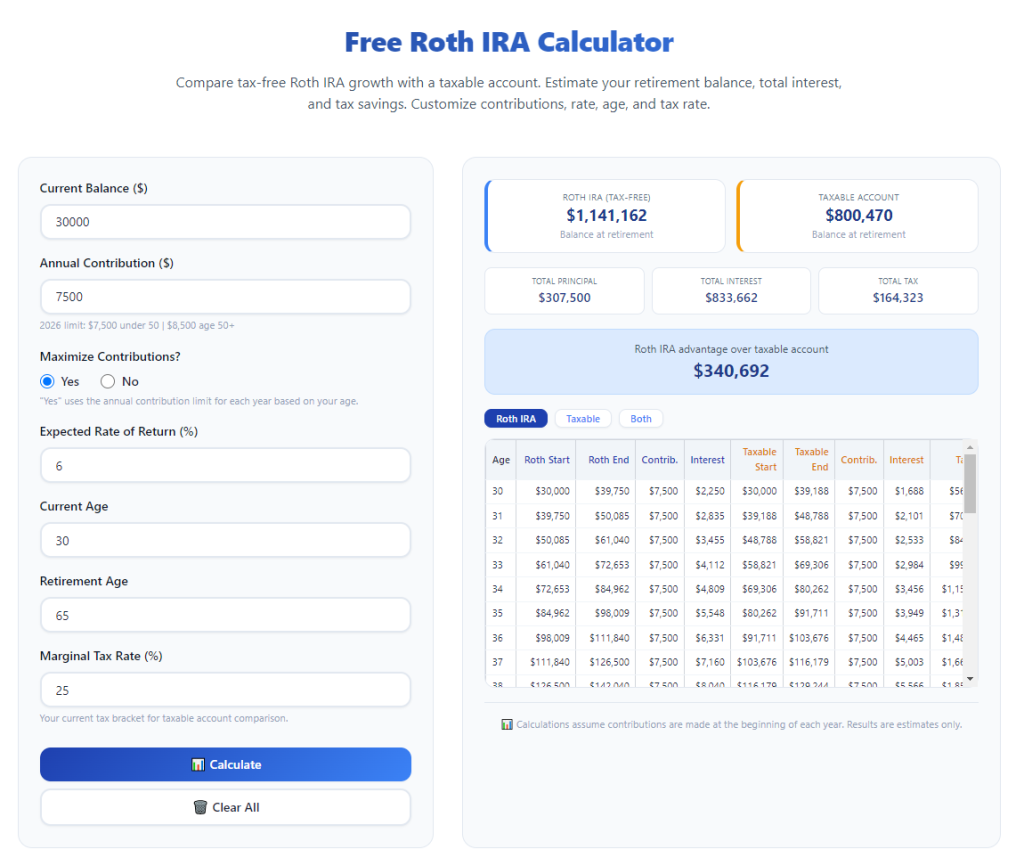
A dedicated Roth IRA calculator built for long-term retirement projections solves this critical planning gap. Mastering how to use Roth IRA calculator for retirement projections lets you build data-backed savings targets, tweak monthly deposits, and test different market scenarios before you lock in your yearly contribution budget.
This comprehensive beginner’s guide breaks down the limitations of manual retirement math, core advantages of purpose-built Roth IRA projection tools, mandatory input parameters, common real-world planning use cases, and a fully actionable step-by-step workflow for precise, realistic retirement forecasting.
Why Manual Retirement Math Fails Roth IRA Savers
Most people rely on rough mental calculations or basic spreadsheets to estimate their Roth IRA future value, but these methods carry consistent, costly flaws that skew long-term retirement projections.
Subjective guesswork for growth rates
Every investor’s personal market outlook distorts manual math. It’s easy to overestimate annual investment returns or ignore sustained inflation, which erodes the buying power of your Roth withdrawals after retirement. A calculator standardizes realistic market ranges to eliminate biased assumptions.
Failure to account for annual Roth contribution caps
Roth IRAs carry fixed yearly contribution maximums that shift over time. Manual math often forgets these hard limits, leading users to build unattainable savings plans that overstate how much they can legally deposit each tax year.
No built-in inflation adjustment logic
Cash value alone means nothing for retirement. Even large projected account balances shrink in purchasing power due to consistent inflation. Handwritten calculations rarely factor in yearly cost-of-living increases for post-retirement spending.
Complex tax-free growth rules hard to compute manually
Unlike traditional pre-tax retirement accounts, Roth IRA withdrawals in retirement carry zero federal income tax. Calculating the lifetime tax advantage of this structure requires layered compound interest formulas most people cannot compute without automated tools.
Lack of scenario comparison functionality
Manual spreadsheets force users to rewrite every number to test different plans—such as retiring early, cutting monthly contributions, or shifting to more conservative investments. This repetitive work discourages testing multiple retirement pathways.
Time-intensive recalculation for updated plans
Life changes like raises, career breaks, or extra one-time Roth deposits require full recalculation of all growth figures. Manual math wastes hours every time your income or savings strategy shifts.
Core Benefits of Mastering How to Use Roth IRA Calculator for Retirement Projections
Integrating regular Roth IRA projection tool sessions into your yearly financial review delivers measurable advantages for short-term budgeting and long-term retirement security once you fully learn how to use Roth IRA calculator for retirement projections.
Generate tax-adjusted, inflation-corrected retirement forecasts
Top-tier Roth IRA calculators separate nominal account balance totals from inflation-adjusted spending power. You receive two key projections: raw total account value at retirement age, and the real monthly purchasing power you can safely withdraw without draining your savings early.
Instantly test unlimited contribution scenarios
You can plug in different monthly or yearly Roth deposit amounts in seconds to see the direct impact on your 30-, 40-, or 50-year retirement balance. This makes it simple to decide whether to boost monthly savings after a raise or cut contributions temporarily during tight budget cycles.
Account for legal annual contribution limits automatically
Quality tools pre-program current Roth IRA maximum deposit rules by income bracket and age tier. The calculator flags over-limit input values and adjusts projections to comply with IRS guidelines, eliminating costly over-contribution mistakes during your planning process.
Compare aggressive, moderate, and conservative market return models
Retirement projection calculators include three standard asset growth profiles matching common Roth investment portfolios: high-growth stock-heavy mixes, balanced stock/bond allocations, and low-risk conservative bond-focused holdings. You can instantly see how market volatility impacts your final retirement fund.
Calculate safe annual post-retirement withdrawal rates
The tool embeds widely accepted sustainable withdrawal formulas designed to prevent running out of money late in life. It shows exactly how much tax-free monthly income your Roth IRA can support once you stop full-time work, aligned with your projected lifespan.
Streamline yearly financial planning workflows
What once took hours of spreadsheet editing takes under two minutes with a dedicated Roth IRA calculator. You can complete full retirement projections during annual tax prep, quarterly budget reviews, or after major life income changes with minimal effort.
Build clear, trackable long-term savings milestones
The calculator outputs yearly account growth benchmarks you can reference every January. You can measure your actual Roth IRA balance against the projected target and adjust contributions immediately if you fall behind your retirement savings timeline.
Must-Have Features in a Reliable Roth IRA Calculator for Retirement Projections
Not all online retirement calculators are optimized specifically for Roth IRA tax rules and long-term forecasting. When selecting a tool to learn how to use Roth IRA calculator for retirement projections, prioritize these saver-focused, IRA-specific core features.
Roth-specific tax growth modeling
Generic retirement calculators mix pre-tax and post-tax account math. Purpose-built Roth projection tools fully exclude income tax from all post-retirement withdrawal calculations, accurately reflecting the unique tax benefit of Roth IRA accounts.
Dual inflation and nominal value reporting
Avoid basic calculators that only show raw dollar totals. The best tools display both unadjusted future balance and inflation-adjusted equivalent value to paint a realistic picture of your retirement spending power decades from now.
Tiered annual contribution limit lock-ins
The calculator must automatically cap yearly deposits at official IRS maximums split by age groups and modified adjusted gross income thresholds. It should alert users when input contributions exceed legal limits and recalculate projections accordingly.
Variable market return scenario sliders
Look for adjustable average annual return inputs split into short-term working years and post-retirement withdrawal years. This lets you model shifting portfolio risk as you near your planned retirement age.
Early retirement penalty calculation module
If you plan to access funds before the official qualified distribution age, the tool should calculate applicable early withdrawal penalties and subtract these costs from your total projected balance for accurate early-retirement forecasting.
One-time extra contribution input field
Many savers make lump-sum Roth deposits from bonuses, tax refunds, or windfall income. A robust calculator includes a dedicated field for single-year extra contributions to reflect one-time savings boosts in long-term projections.
Lifespan and withdrawal duration customization
Customizable fields for planned retirement age and estimated lifespan let you tailor projections to your personal timeline, rather than relying on generic one-size-fits-all retirement assumptions.
Side-by-side scenario comparison views
Top tools let you save multiple projection sets side-by-side. You can compare two or three different contribution, retirement age, or investment risk plans without retyping all base input data repeatedly.
Common Real-World Use Cases for Roth IRA Retirement Projection Calculators
Once you fully grasp how to use Roth IRA calculator for retirement projections, you can apply this tool to nearly every major personal financial decision tied to long-term savings and post-work planning.
Young entry-level worker baseline retirement planning
People early in their careers with modest monthly Roth deposits use the calculator to see the massive compound growth advantage of starting savings young. Projections highlight how even small consistent monthly contributions build substantial tax-free retirement wealth over 40+ working years.
Mid-career income raise contribution adjustment
After receiving a salary increase, savers test raising their monthly Roth deposit amount via the calculator to view the compound growth difference over their remaining working timeline. This data-driven insight removes guesswork from deciding how much extra income to allocate to retirement savings.
Early retirement feasibility testing
Users considering leaving full-time work years before standard retirement age input their target early exit date into the calculator. The tool factors in early withdrawal penalty risks, shorter contribution windows, and longer post-retirement withdrawal periods to show whether their current savings rate supports an accelerated retirement timeline.
Portfolio risk adjustment planning
Investors debating shifting their Roth asset mix from aggressive stocks to balanced or conservative holdings run separate projections with different average return values. The side-by-side results show the tradeoff between higher growth potential and lower market volatility risk for their retirement fund.
Windfall one-time deposit forecasting
Anyone receiving a tax refund, work bonus, inheritance, or other lump sum can input the extra one-time Roth contribution to measure the long-term compound value of adding that single deposit to their account. This quantifies the lasting retirement benefit of directing windfall cash to tax-free Roth savings.
Household dual-income joint retirement planning
Couples each with separate Roth IRA accounts run individual projections, then combine the two forecasted balances to calculate total combined household tax-free retirement income. This joint forecasting simplifies shared household retirement budget planning.
Catch-up contribution timeline planning
Users age 50 and older qualify for annual Roth catch-up contributions above standard limits. The calculator automatically applies the higher age-based deposit cap and projects the additional growth these extra yearly contributions add to their final retirement fund balance.
Post-retirement monthly withdrawal budget building
Near-retirement savers input their full projected Roth balance, planned retirement age, and estimated lifespan to generate a safe, sustainable monthly tax-free withdrawal amount. This number becomes the baseline for building their full post-work monthly spending budget.
Step-by-Step Complete Workflow: How to Use Roth IRA Calculator for Retirement Projections
Follow this structured, repeatable process every time you run retirement forecasts to generate consistent, realistic Roth IRA growth projections with any qualified online tool.
Step 1: Gather all required personal and financial input data first
Before opening the calculator, compile every number the tool will request to avoid mid-session interruptions. Collect these core data points:
- Your current age and target full retirement age
- Current total balance held inside your existing Roth IRA account
- Planned regular monthly or yearly Roth contribution amount
- Any one-time lump-sum extra deposits you intend to add this tax year
- Your current annual household income (to verify Roth contribution eligibility limits)
- Target average annual investment return split for working years and retirement years
- Estimated average yearly inflation rate for long-term forecasting
- Estimated lifespan or total number of years you plan to withdraw funds post-retirement
- Planned age for first qualified Roth withdrawals (to calculate early penalties if applicable)
Step 2: Launch the dedicated Roth IRA retirement projection calculator
Open the tool in your browser and ignore generic multi-purpose finance calculators that do not label themselves as Roth IRA-specific forecasting tools. Locate the primary data entry panel split into clear sections for personal details, current account balance, contribution inputs, market assumptions, and withdrawal timeline settings.
Step 3: Fill out base personal timeline parameters
Input your current age first, followed by your exact target retirement age. Enter your estimated lifespan or total planned withdrawal years after stopping full-time work. Double-check these numbers because the calculator’s entire withdrawal projection math relies on this timeline framework.
Step 4: Enter your existing Roth IRA account principal balance
Type the exact current total dollar value of all funds held in your active Roth IRA accounts. Do not round this number up or down; precise principal balance inputs deliver far more accurate long-term growth projections. If you do not yet have an open Roth IRA, input a starting balance of zero.
Step 5: Input regular recurring contribution amounts
Select either monthly or yearly contribution frequency matching your actual deposit schedule. Enter the exact dollar amount you plan to transfer to your Roth IRA each cycle. The tool will automatically flag values exceeding current age-based IRS annual contribution maximums and notify you to adjust the figure to stay compliant.
Step 6: Add one-time lump-sum extra contributions (if applicable)
Locate the dedicated one-time deposit field and input any bonus, tax refund, or windfall cash you plan to add to your Roth within the current tax year. The calculator will compound this single lump sum alongside your regular recurring contributions for accurate total growth forecasting. Skip this field if you have no planned extra deposits for the year.
Step 7: Set realistic market growth and inflation assumptions
Adjust the average annual return sliders for two distinct periods: your working accumulation years and your post-retirement withdrawal years. Use lower return figures for retirement-era portfolios, as most savers shift to less volatile asset mixes once they stop working. Next, input a standard long-term average inflation rate consistent with historical economic trends for purchasing power adjustment calculations.
Step 8: Toggle early withdrawal penalty settings if retiring before qualified age
If your target retirement age falls below the official threshold for penalty-free Roth distributions, activate the early withdrawal calculation function within the tool. The calculator will subtract applicable penalty fees from your final projected account balance and reduce your safe monthly withdrawal estimate accordingly. Skip this toggle if you plan to wait for fully qualified tax-and-penalty-free withdrawals.
Step 9: Run the full Roth IRA retirement projection calculation
Review all entered data one final time to catch typos or misplaced values, then select the calculate or generate projection button. The tool will process all compound interest, tax, inflation, and timeline formulas in seconds and display a complete multi-section retirement forecast report.
Step 10: Analyze the two core projection results sets
First review the nominal raw balance forecast: this shows the total unadjusted dollar amount your Roth IRA will hold once you hit retirement age, plus yearly incremental growth benchmarks for every working year ahead. Second, examine the inflation-adjusted purchasing power breakdown, which displays the real monthly tax-free income you can safely withdraw without depleting your savings before your estimated lifespan ends.
Step 11: Test alternative scenario adjustments
To build flexible retirement plans, modify one variable at a time and recalculate projections for side-by-side comparison. Common scenarios to test include: raising monthly contributions by $100, delaying retirement by five years, shifting to a more conservative investment return profile, or adding a large one-time lump sum deposit. Save each separate projection set to compare outcomes clearly.
Step 12: Adjust your real-world Roth savings strategy based on results
If the projected safe monthly withdrawal falls short of your target post-retirement spending budget, use the calculator’s scenario testing to identify actionable fixes: boost recurring contributions, delay retirement, allocate larger lump-sum windfalls to the Roth, or slightly increase long-term portfolio risk for higher average growth. If projections exceed your income needs, you can safely reduce monthly deposits and redirect excess cash to other financial goals.
Step 13: Save the finalized projection report for annual financial reviews
Copy or export your primary baseline projection data to a personal finance document folder. Repeat this full calculator workflow every 12 months during tax planning season, updating your current Roth balance, income, and contribution targets to refresh your long-term retirement forecast with up-to-date real financial data.
Common Costly Mistakes to Avoid When Using Roth IRA Calculator for Retirement Projections
Even after learning how to use Roth IRA calculator for retirement projections, these frequent input and assumption errors drastically skew forecast accuracy and lead to flawed retirement savings decisions.
Entering rounded or estimated current Roth account balances
Rounding your existing principal balance up or down by hundreds or thousands of dollars creates compounded projection errors over decades. Always input the exact verified account balance pulled directly from your IRA provider statement.
Ignoring annual IRS contribution limit alerts
Many users dismiss the tool’s over-limit contribution warning and leave inflated deposit values in place. Projections built on illegal over-contributions produce unattainable, overly optimistic retirement balance forecasts that cannot be replicated in real life.
Using identical high market return rates for working and retirement years
Savers often apply aggressive stock-market average returns to their post-retirement portfolio phase. This overestimates growth after retirement, when most investors shift to lower-risk, lower-yield asset mixes and produce unrealistic withdrawal income estimates.
Skipping inflation adjustment entirely
Focusing solely on nominal raw dollar totals without reviewing inflation-adjusted purchasing power creates a false sense of financial security. A large projected balance will buy far less goods and services 30–40 years from now due to consistent cost-of-living increases.
Failing to model early withdrawal penalties for pre-qualified retirement plans
Users planning to exit the workforce early often disable penalty calculations, leading the calculator to overstate available monthly retirement income. Unaccounted early distribution fees permanently reduce your total accessible Roth funds.
Running only a single projection scenario with no comparison testing
Relying on one static forecast ignores the range of possible market outcomes and contribution flexibility. Without testing multiple contribution, risk, and retirement age scenarios, you cannot build a resilient backup retirement savings plan for economic shifts.
Updating calculator projections only once every several years
Long gaps between recalculations mean you miss opportunities to adjust contributions when your income rises or falls. Annual recalculation catches savings shortfalls decades before retirement, giving you plenty of time to correct your deposit strategy gradually.
Overlooking one-time lump-sum contribution opportunities
Users leave the extra deposit field blank even when expecting bonuses or tax refunds. This understates total long-term compound growth by ignoring meaningful one-time cash infusions that drastically boost final retirement balances.
Expert Pro Tips to Maximize Accuracy From Your Roth IRA Retirement Calculator
Leverage these proven financial planning tactics every time you run forecasts to get the most reliable, actionable results now that you understand how to use Roth IRA calculator for retirement projections.
- Bookmark your preferred Roth-specific calculator for instant access during monthly budget checks and yearly tax planning sessions to eliminate repeated tool search delays.
- Build a consistent baseline inflation and average return assumption set you reuse for every projection to create comparable year-over-year retirement growth benchmarks.
- Test incremental monthly contribution raises of $50 or $100 to visualize the compound growth impact of small, sustainable savings increases after receiving pay raises.
- Separate joint household Roth projections for each spouse before combining the two final inflation-adjusted withdrawal totals to calculate total combined family retirement income.
- Run projections with both conservative and moderate market return profiles to create a best-case and worst-case retirement savings range for risk-aware planning.
- Schedule a quarterly quick check-in projection whenever you make a major financial change: job switch, bonus payout, inheritance, or adjustment to your monthly Roth deposit amount.
- Use the calculator’s yearly growth milestone output to set tangible annual Roth savings targets you can track against your actual account statement each January.
- Pair your Roth IRA projection results with estimates from other retirement accounts (401k, taxable brokerage) to build a complete full household retirement income picture, rather than planning around your Roth alone.
Final Thoughts
Retirement planning does not require guesswork or complex manual compound interest math once you master how to use Roth IRA calculator for retirement projections. This specialized financial tool translates abstract long-term savings habits into concrete, inflation-adjusted monthly income numbers you can rely on to build a secure post-work lifestyle.
Manual calculations fail to account for Roth’s unique tax-free growth rules, yearly contribution caps, market volatility, and decades of compound inflation, leaving most savers unaware of critical retirement funding gaps until it is too late to adjust their savings strategy comfortably.
A purpose-built Roth IRA projection calculator removes all these blind spots, letting you test unlimited contribution, retirement age, and investment risk scenarios in minutes. When used consistently on an annual basis with precise, unrounded financial input data, this tool acts as your core roadmap for tax-free retirement wealth building.
By following the structured step-by-step workflow outlined above and avoiding common input and assumption mistakes, you can generate hyper-realistic retirement forecasts, set achievable Roth savings milestones, and build a flexible long-term financial plan that aligns with your age, income, and ideal post-work lifestyle goals.
After learning the operation method, click the link below to enter the tool page for immediate use.