Every crypto trader’s biggest blind spot is ignoring trading fees when estimating potential profit. Many beginners map out buy and sell price targets only to end up with far smaller returns than expected after exchange charges kick in.
Maker fees, taker fees, withdrawal costs and spread markups chip away at your total gains. Calculating these deductions manually is messy, error-prone, and eats up valuable time before you open a position.
Basic profit calculators skip fee inputs entirely, delivering inflated, unrealistic profit numbers that mislead your trading decisions. Without factoring every charge, your risk and reward analysis will always be incomplete.
Mastering how to use crypto profit calculator with trading fees eliminates this critical mistake. These specialized tools integrate all exchange cost variables to output your exact net profit or loss after every applicable fee deduction.
This comprehensive trader’s guide breaks down the flaws of manual profit math, core tool advantages, mandatory calculator features, common trading use cases, and a detailed step-by-step workflow for accurate fee-inclusive crypto profit analysis.
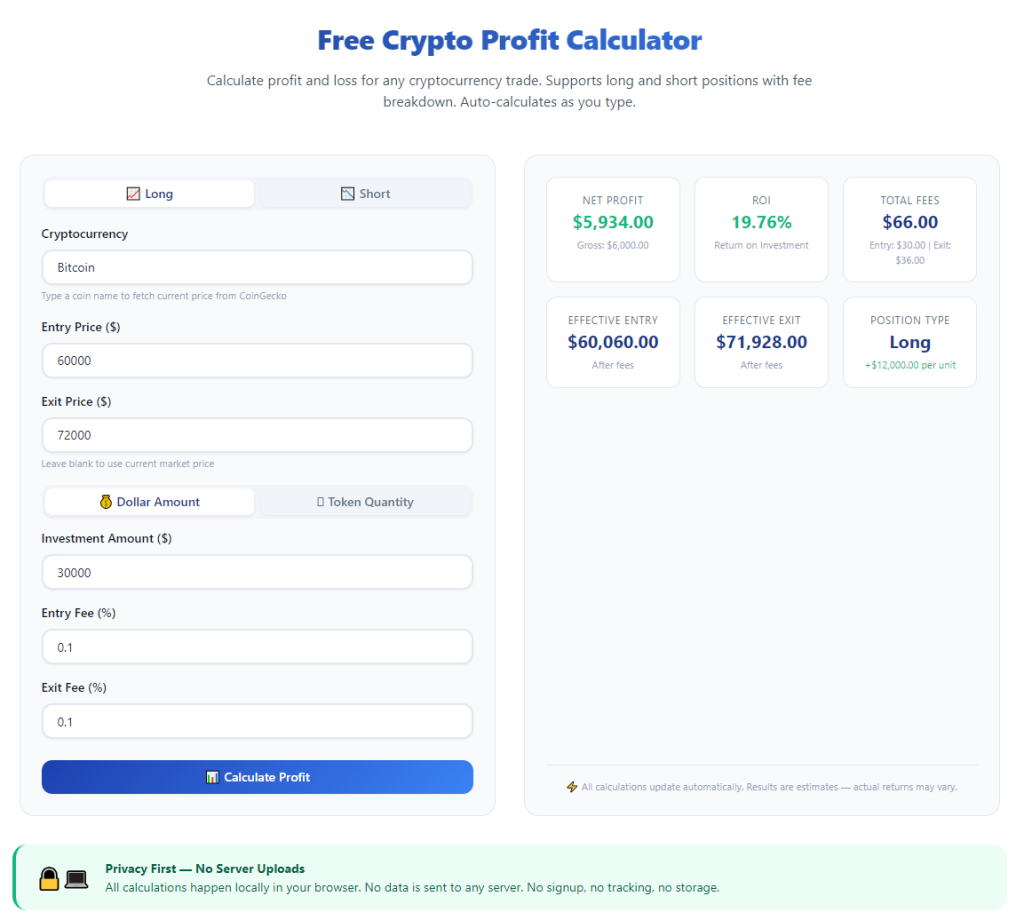
Why Manual Crypto Profit Calculation Fails Traders
Working out crypto profit on scratch paper or generic spreadsheets creates consistent miscalculations that warp your trading strategy over time.
Easy oversight of layered trading fee types
Most new traders only account for one-time taker fees and overlook maker discounts, cross-asset conversion fees, and network withdrawal charges. Missing even one small cost drastically changes net results.
Mental math errors with percentage-based charges
Trading fees apply to both your opening buy order and closing sell order. Manually multiplying your position size against two separate percentage rates creates frequent arithmetic mistakes.
No standardized way to compare fee tiers
Exchanges offer reduced fees for high-volume traders or native token holdings. Manual calculations cannot quickly test how tiered pricing impacts your final profit across different trade sizes.
Slow recalculation for revised entry/exit targets
If you adjust your planned buy price or take-profit level, manual math forces you to redo every fee calculation from scratch. This slows down fast-paced spot and swing trading planning.
Inability to model multiple trade sizes at once
Traders often test small, medium and large position allocations. Running separate manual fee computations for each size becomes repetitive and discourages thorough risk testing.
Key Benefits When You Learn How to Use Crypto Profit Calculator With Trading Fees
Integrating a fee-aware profit calculator into your pre-trade routine delivers tangible improvements to your risk management and return forecasting once you fully understand how to use crypto profit calculator with trading fees.
Generates 100% accurate net profit after all exchange deductions
These dedicated tools input maker, taker, conversion and withdrawal fees as adjustable variables. The final output shows the exact cash or crypto amount you keep after every mandatory charge is subtracted.
Instant comparison of different fee tier scenarios
You can toggle between standard base fees and discounted VIP volume tiers within seconds. This lets you see how trading more frequently or holding exchange tokens boosts your net profit margin long term.
Cuts pre-trade planning time drastically
Instead of spending several minutes scribbling formulas for each trade idea, you plug in six core values and receive a complete profit breakdown in one second. This frees up time for market research and chart analysis.
Eliminates overoptimistic profit forecasting
Tools that ignore trading fees paint an overly positive picture of potential gains. Fee-inclusive calculators ground your expectations in real-world exchange costs, preventing poorly planned high-risk positions.
Works for all major crypto trading styles
Spot traders, swing investors, intraday scalpers and futures position holders all rely on the same calculator framework. Adjustable fee sliders adapt to each style’s unique cost structure.
Simplifies portfolio tracking across multiple trades
You can log each completed trade’s fee-adjusted profit in a consistent format. Uniform calculations make monthly portfolio performance reviews far more reliable and comparable.
Must-Have Features of a Functional Crypto Profit Calculator With Trading Fee Support
Not all crypto profit calculators support detailed fee customization. As you learn how to use crypto profit calculator with trading fees, prioritize tools built with these trader-focused core functions.
Separate input fields for maker and taker percentage fees
Top calculators split limit order maker fees and market order taker fees into independent editable boxes. This matches how every mainstream exchange structures its pricing model.
Optional conversion and withdrawal fee sliders
Premium tools add extra fields for stablecoin conversion fees and blockchain network withdrawal costs. You can toggle these values on or off depending on your planned transfer steps post-trade.
Variable position size and currency denomination support
Input your position in fiat currency or native crypto units. The tool automatically converts values and applies fee percentages evenly regardless of your chosen denomination.
Dual entry for buy price and target sell price
Clear dedicated boxes for your entry cost and planned exit price form the base of all profit math. Every fee deduction references these two core market values consistently.
Break-even price auto-calculation after fees
A standout feature automatically computes the exact sell price you need to hit to offset all trading fees and avoid net losses. This critical metric is nearly impossible to calculate quickly by hand.
Visual breakdown of all deducted costs
Instead of only displaying a single final profit number, quality calculators list each separate fee amount as a line item. You can clearly see how much each exchange charge eats into your potential returns.
Unlimited repeated calculations with no usage caps
The best tools let you test dozens of position sizes, fee tiers and price targets in one session without locked features or session limits for regular traders.
Common Real-World Use Cases for a Fee-Inclusive Crypto Profit Calculator
Once you master how to use crypto profit calculator with trading fees, the tool supports every stage of a crypto trader’s workflow, from pre-position planning to post-trade performance auditing.
Intraday scalping position planning
Scalpers execute dozens of small trades daily, and cumulative taker fees heavily compress tiny profit margins. Running quick calculator checks ensures your target gain per trade covers all associated exchange costs.
Swing trade target profit validation
Swing investors hold positions for weeks or months and often overlook combined buy and sell fees. The calculator verifies whether your planned take-profit level delivers acceptable net returns after double-sided charges.
High-volume VIP fee tier comparison
Traders considering increasing monthly trade volume to unlock discounted fees can model two scenarios side-by-side. The tool shows exact profit differences between standard and reduced fee structures.
New coin spot position risk analysis
When trading newly listed altcoins with elevated exchange fees, the calculator flags how much extra cost impacts your risk-to-reward ratio before you allocate capital.
Post-trade portfolio profit reconciliation
At the end of each month, input closed trade data to generate accurate net profit figures including fees. This standardized data simplifies personal trading performance tracking.
Cross-exchange fee cost testing
If you split trading activity across multiple platforms with different fee schedules, reuse the calculator to model identical positions on each exchange and identify which venue delivers higher net gains.
Long-term hold partial sell planning
When taking partial profits from long-held crypto holdings, input your fractional sell size and applicable taker fees to avoid miscalculating leftover portfolio value after the transaction completes.
Step-by-Step Complete Guide: How to Use Crypto Profit Calculator With Trading Fees
Follow this simple, trader-focused workflow to generate fully fee-adjusted crypto profit calculations with zero avoidable errors every single time.
Step 1: Gather all required trading variables before opening the calculator
First collect every numerical value the tool requires to run a complete fee-inclusive analysis. Missing even one fee percentage will skew your entire result.
Write down your total planned position size, entry buy price, target sell price, and your exchange’s current maker and taker fee percentages.
If you plan to convert stablecoins or withdraw crypto post-trade, note those flat or percentage fee values as well for full accuracy.
Step 2: Launch the crypto profit calculator tool and locate core input panels
Open the calculator interface in your browser. The page will separate basic trade data inputs and dedicated trading fee adjustment panels into distinct, easy-to-read sections.
Spend two seconds identifying key labeled fields: position size, entry price, exit price, maker fee, taker fee, and optional extra cost inputs.
Step 3: Input your core trade position and price data
Start filling out the base trade information first. Enter your full position size either in fiat currency or the native crypto token you intend to trade.
Type your exact planned buy entry price and your primary take-profit sell target price into their respective text boxes. Double-check decimal precision for low-value altcoins.
Step 4: Customize all trading fee parameters to match your exchange
Navigate to the dedicated trading fee section of the calculator. This is the most critical step when learning how to use crypto profit calculator with trading fees.
Input your exchange’s active taker fee percentage for market orders, and the maker fee rate if you plan to place limit orders to cut costs.
Add conversion or withdrawal fees if your trade workflow includes those steps; leave these fields set to zero if you hold crypto on the platform long-term with no immediate transfers.
Step 5: Toggle order type to match your planned execution style
Most calculators include a simple toggle switch to select market taker orders or limit maker orders. This switch auto-applies the corresponding fee percentage you entered in the prior step.
If you intend to open via limit order and close via market order, run two separate calculations to model each leg’s unique fee deduction separately.
Step 6: Run the full profit and fee analysis
Click the calculate or compute button to trigger the tool’s formula engine. The system processes all position, price and fee variables instantly without waiting periods.
The screen will populate two core outputs: your gross profit before fees, and your final net profit after every trading cost has been fully subtracted.
Step 7: Review the itemized breakdown of all deducted trading fees
Scroll down to view the line-item cost breakdown panel. This section lists the total buy-order fee, total sell-order fee, and any extra conversion or withdrawal charges as separate dollar or crypto values.
Compare the total combined fee amount against your projected gross profit to judge if the trade’s risk-reward ratio still meets your personal trading standards.
Step 8: Check the auto-generated break-even price metric
Locate the break-even price calculation displayed alongside your profit numbers. This number tells you the minimum sell price needed to completely offset all trading fees and avoid a net loss on the position.
If your target sell price sits barely above this break-even level, consider adjusting your entry position size to improve your margin buffer against minor market volatility.
Step 9: Test alternate scenarios by adjusting fee and price variables
To strengthen your risk planning, tweak one variable at a time and recalculate to observe how net profit shifts. Common tests include higher taker fees, smaller position sizes, or lower exit price targets.
For example, lower your sell price by a small percentage to simulate a market pullback and see if you still retain positive net profit after all exchange fees.
Step 10: Save or record your finalized fee-adjusted profit data
Copy the full calculation breakdown (position size, fees, gross profit, net profit, break-even price) into your personal trading journal or spreadsheet for future reference.
Repeat the entire workflow for every new trade idea before you submit any buy orders to your exchange, ensuring consistent fee-aware forecasting for all positions.
Common Costly Mistakes to Avoid When Using a Crypto Profit Calculator With Trading Fees
Even after learning how to use crypto profit calculator with trading fees, these frequent user errors produce misleading profit estimates that hurt trading performance.
Inputting only one-sided fees instead of buy + sell charges
Many traders only add the sell taker fee and leave the buy fee field blank. Every completed round trip trade incurs two separate exchange charges, and omitting one inflates projected profit artificially.
Using generic default fee rates that do not match your exchange
Calculators ship with average preset fee percentages as placeholders. If you fail to update these numbers to match your actual platform’s tiered pricing, all results will be inaccurate.
Ignoring extra conversion and withdrawal fees entirely
If you convert fiat to stablecoins then trade altcoins, conversion fees stack onto standard trading costs. Leaving these values at zero creates an incomplete picture of total transaction expenses.
Running calculations once and skipping alternate market downside scenarios
Only testing your ideal take-profit price ignores volatility risk. Always recalculate with a lower secondary exit target to confirm fees do not push you into a net loss during minor price dips.
Mixing maker and taker fee percentages incorrectly
Maker fees are always lower than taker fees. Swapping the two values in input fields drastically understates your total trading costs and delivers unrealistic profit projections.
Forgetting decimal precision for low-price micro altcoins
Small-value tokens require careful decimal entry for entry and exit prices. Minor typos in decimal places compound alongside fee calculations and create wildly off-base profit figures.
Pro Trader Tips to Maximize Accuracy When Using a Fee-Inclusive Crypto Profit Calculator
Use these field-tested strategies to get the most reliable forecasts every time you practice how to use crypto profit calculator with trading fees for pre-trade planning.
- Bookmark your preferred calculator tool for one-click access before every market analysis session to avoid skipping fee calculations out of convenience.
- Save a permanent note of your exchange’s current maker, taker and conversion fee percentages to copy-paste into the calculator without repeated manual lookup.
- Run separate calculations for limit maker orders and market taker orders to compare how using limit orders boosts your final net profit margin over time.
- Build a monthly log of calculator results for closed trades to track how cumulative trading fees eat into your overall portfolio returns across market cycles.
- Test multiple position size increments in one sitting to find the smallest trade size where fee deductions do not erase your target profit margin entirely.
- Always reference the itemized fee breakdown instead of only glancing at the final net profit number to identify which exchange charges impact your gains the most.
- Update your stored fee values quarterly, as many platforms adjust tiered trading pricing or add new hidden conversion fees periodically.
Final Thoughts
Trading fees represent an unavoidable, often underestimated cost layer within every crypto position. Ignoring these deductions leads to flawed risk assessment and persistent disappointment when realized returns fall short of your original forecasts.
Manual profit math cannot compete with the speed, precision and scenario-testing power of a dedicated calculator built to account for every type of exchange charge. Generic profit tools that omit fee fields offer minimal value to active traders.
Learning and consistently applying how to use crypto profit calculator with trading fees levels up your entire trading workflow. The tool eliminates guesswork, grounds your profit targets in real exchange costs, and highlights break-even thresholds critical for risk management.
Whether you are a casual spot investor, frequent intraday scalper, or long-term swing trader, fee-adjusted profit calculations remove the optimism bias that skews so many new crypto market participants’ decision-making.
By following the structured step-by-step workflow, avoiding common input mistakes, and testing alternate price and fee scenarios, you can generate consistent, accurate net profit projections that guide more profitable, risk-conscious crypto trading every single session.
After learning the operation method, click the link below to enter the tool page for immediate use.