If you’ve ever opened up a simple interest calculator and stared blankly at the input boxes wondering what exactly you’re supposed to type, you’re so not alone. I’ve been in that exact spot more times than I’d like to admit.
When I first started working with simple interest math for school assignments and personal budget practice, I thought the calculator would do all the hard work for me. I figured I just plug in some numbers and get an answer instantly. Turns out, that mindset led to so many wrong calculations.
I’d randomly fill in fields, guess at what each input meant, and end up with results that didn’t match my textbook answers or manual math. Back then, I had no clue what inputs do I need for simple interest calculator tools to work correctly.
After wasting hours redoing homework and troubleshooting messed-up interest estimates, I finally learned exactly which inputs matter, why they matter, and how tiny input errors ruin your entire result. This guide breaks down every single required entry in plain, casual English, no fancy finance jargon at all.
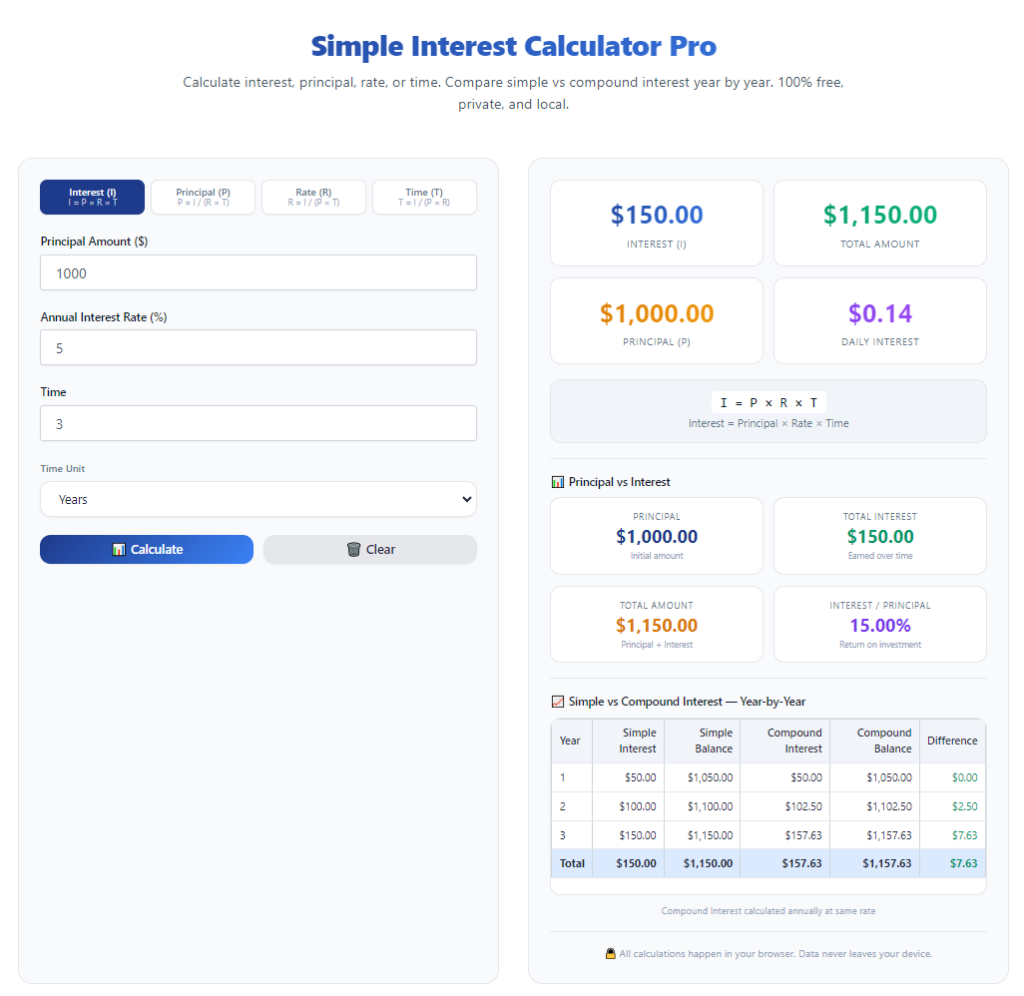
Why Calculator Inputs Matter More Than You Think
Here’s the honest truth: simple interest calculators are incredibly dumb if you feed them bad data. They don’t correct your mistakes, they don’t guess what you mean, and they can’t read your mind.
Every inaccurate simple interest calculation I’ve ever made boiled down to one simple issue: wrong or incomplete inputs. Not confusing math formulas, not broken calculators, just basic human error when filling out fields.
A lot of beginners rush through the process. They skip reading field labels, mix up different values, or leave optional boxes blank without realizing those boxes impact the final tally. If you want clean, correct results every single time, you have to nail down the core input fields for simple interest calculation.
Once you master these basic inputs, using any simple interest calculator becomes effortless. You’ll stop second-guessing your entries and never have to redo a calculation due to silly input mistakes again.
What Inputs Do I Need for Simple Interest Calculator? (Mandatory Fields)
Let’s cut straight to the point. Every reliable simple interest calculator relies on three non-negotiable input values. You cannot get an accurate result if any of these three entries are missing or incorrect. These are the standard inputs every tool is built around, no exceptions.
1. Principal Amount (Core Starting Value)
The very first input box you’ll always see is for your principal amount. This is literally just your original sum of money. It’s the base number your interest calculation is built entirely on.
Whether you’re calculating interest for a personal loan, a savings deposit, or a math homework problem, the principal is your starting balance before any interest is added. No extra fees, no accumulated interest, just the initial cash value.
This is one of the easiest inputs to get right, but it’s also where small typos happen constantly. I’ve accidentally added an extra zero before, turning a small principal into a huge one and completely skewing my final interest number.
For correct data entries for simple interest tools, always type only raw numeric values. Skip dollar signs, commas, and symbols. Most calculators reject special formatting and will either error out or compute wrong values if you include them.
2. Annual Interest Rate
The second mandatory input is your annual interest rate. This is the percentage rate applied to your principal over a full year, and it’s the driving factor behind how much interest you earn or owe.
This input tripped me up so much when I was new. I constantly confused decimal rates with whole percentage numbers, and I often mixed up monthly rates with annual rates without realizing the difference.
Nearly all standard simple interest calculators are programmed for annual percentage rates. If your problem or loan terms list a monthly rate, you have to convert it to an annual rate first before inputting it. Failing to do this creates massive calculation gaps.
Most beginner-friendly tools let you type the whole number (like 4 for 4%) instead of a decimal, which simplifies things. Still, always double-check your tool’s instructions to make sure you’re entering the rate correctly for accurate outputs.
3. Time Duration & Time Unit
The third essential input is your time duration, paired with the correct time unit. This is hands down the most error-prone input on every simple interest calculator I’ve ever used.
The time value represents how long the principal amount holds the applied interest rate. It can be measured in years, months, or days, depending on your problem or financial scenario.
Here’s the huge mistake I see everyone make: plugging in raw month or day numbers when the calculator defaults to years. I once input 8 for an 8-month term instead of converting it to roughly 0.67 years, and my interest result was wildly overinflated.
Mastering this input is the secret to how to fill out a simple interest calculator accurately. Always match your numeric time value to the selected unit on the tool. Never mix units or skip conversions.
Are There Any Optional Inputs on Simple Interest Calculators?
A lot of new users wonder if there are extra boxes they need to fill in. The short answer is no—pure simple interest calculators have zero mandatory optional fields.
Some advanced tools add extra inputs for things like final balance display adjustments or custom rounding settings, but these are totally unnecessary for basic simple interest math. They don’t impact the core interest calculation at all.
I used to overcomplicate things by filling out every single optional field I saw, thinking it would make my results more precise. It actually just created more room for errors and confusion.
If you’re working on schoolwork, basic budgeting, or simple loan estimates, stick strictly to the three core inputs. Ignore all extra optional settings entirely.
Most Common Simple Interest Calculator Input Mistakes to Avoid
Now that you know exactly what inputs you need, let’s cover the most frequent errors people make. These are the simple interest calculator input mistakes to avoid that I’ve learned through years of messy, trial-and-error practice.
First, mismatched time units and numeric values. This is the number one mistake globally. If your calculator is set to years, do not input month numbers. Always convert partial years into decimal values for perfect accuracy.
Second, incorrect rate formatting. Never input decimal percentages if the tool asks for whole numbers, and vice versa. A tiny formatting error here changes your entire interest output drastically.
Third, typographical errors in principal values. Extra zeros, missing digits, and misplaced decimals are super common and super destructive to your final result. Always double-check your principal input before calculating.
Fourth, using compound interest mode by accident. Many calculators toggle between simple and compound interest. Even if your inputs are perfect, being in the wrong mode will produce completely wrong answers.
Fifth, copying problem values without verifying. Sometimes textbook or loan numbers have fine print like “monthly rate” or “semi-annual compounding”. Skipping over these details leads to wrong input selections every single time.
Step-by-Step Input Process for Perfect Simple Interest Results
I’m going to walk you through my personal routine for filling out a simple interest calculator. This casual, repeatable process eliminates almost all input errors and takes less than 30 seconds total.
First, pull your three core values from your problem or financial record: exact principal amount, official annual interest rate, and verified time duration with its unit type.
Second, confirm your calculator is set to pure simple interest mode. Double-check no compound interest settings are enabled. This is my first check every single time now, after learning my lesson years ago.
Third, input your principal amount with only numeric digits. Delete any commas, currency symbols, or spaces to prevent tool glitches.
Fourth, type in your annual interest rate following the tool’s format rules. If it accepts whole numbers, use whole numbers. If it needs decimals, convert accordingly.
Fifth, select your correct time unit (years, months, days) and input your converted time value. Never skip unit conversion for partial annual terms.
Sixth, scan all three input fields one final time for typos or mismatched units. If everything looks clean, hit calculate to get your accurate simple interest total.
Real-World Input Example for Clear Understanding
Let’s use a super common everyday scenario to put all these input rules into practice. This example mirrors typical school homework and basic personal finance calculations.
Suppose you have a principal deposit of $6,000, an annual interest rate of 5%, and a savings term of 18 months. Let’s break down the correct inputs step by step.
First, principal input is 6000 (no commas or symbols). Second, interest rate input is 5 (standard whole number for most tools). Third, convert 18 months to 1.5 years and set the time unit to years.
With these correct inputs, the calculator generates an accurate simple interest value with zero errors. If you skipped the conversion and input 18 with a year unit, your result would be astronomically wrong.
This example perfectly shows why understanding every required input is so critical. It’s not just about typing numbers—it’s about typing the right formatted numbers with matching units.
Why Mastering Calculator Inputs Saves You Time & Stress
A lot of people treat calculator inputs like a trivial step, but it’s the foundation of every correct simple interest calculation. Once you fully answer the question of what inputs do I need for simple interest calculator, every future calculation becomes effortless.
You’ll stop second-guessing your results, stop redoing homework problems, and stop stressing over whether your budget estimates are accurate. You’ll build consistent habits that eliminate human error entirely.
I used to spend 10 minutes troubleshooting wrong interest results every time I practiced. Now that I know exactly which inputs matter and how to format them correctly, each calculation takes mere seconds.
Whether you’re a student finishing math homework, a new learner studying basic finance, or someone planning personal savings and loans, clean input habits make all the difference.
Final Key Takeaways
To recap simply, you only need three core inputs for any standard simple interest calculator: accurate principal amount, verified annual interest rate, and properly converted time duration with matching units.
Ignore optional fields, double-check unit conversions, avoid common formatting mistakes, and always confirm simple interest mode is active. These small, intentional steps guarantee perfect results every single time.
You don’t need advanced math skills or financial knowledge to master simple interest calculator usage. You just need to understand your required inputs and fill them out carefully, without rushing through the process.
After learning the operation method, click the link below to enter the tool page for immediate use.